What Global Wealth Trends Mean for the 30A Luxury Real Estate Market

Last updated: July 2026
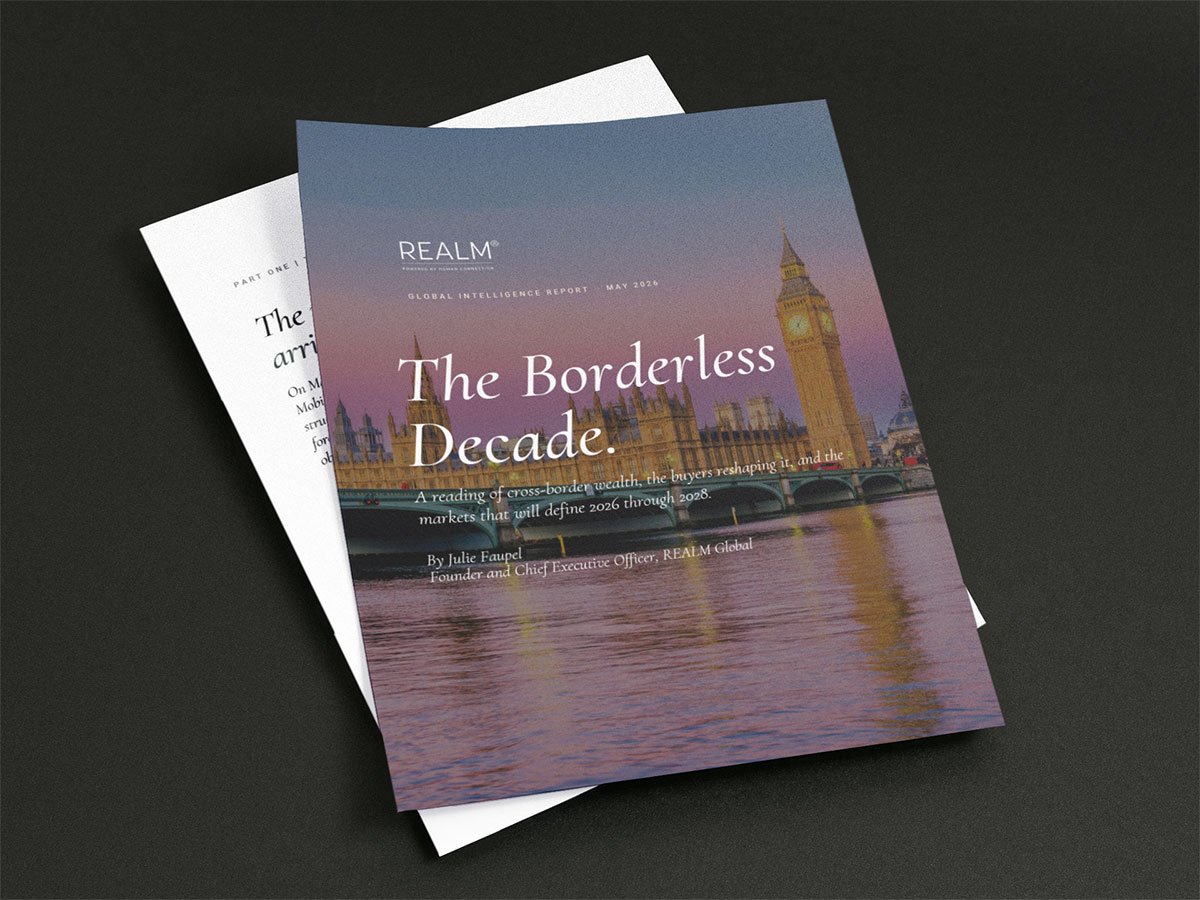
A REALM global intelligence report published in May 2026, The Borderless Decade, describes wealth detaching from geography, a changing wealth holder, and the rise of lifestyle-anchored branded residences. On 30A and the Emerald Coast, these are not forecasts. They describe how the 30A luxury real estate market already works, and why reading the coast neighborhood by neighborhood, backed by relationship-led advisory, matters more as the buyer pool globalizes.
Most buyers who purchase on 30A have never lived here. They arrive from Atlanta, Nashville, Dallas, and increasingly from outside the country. A REALM global intelligence report published in May 2026, The Borderless Decade, describes a luxury market in which wealth has detached from any single geography. For the 30A luxury real estate market, that reads less as a prediction than as a description of how business has worked for twenty years. This post reads the report through the Emerald Coast: who is buying, what they are actually buying, and why the way a home is represented now shapes the outcome as much as the home itself.
In this article
- Why the borderless buyer was always the 30A buyer
- The new wealth holder is reshaping who buys on the Emerald Coast
- Branded residences and the shift from home to ecosystem
- One market is really many: reading 30A neighborhood by neighborhood
- Why relationship-led advisory still decides the outcome
- Frequently asked questions
Why the Borderless Buyer Was Always the 30A Buyer
The report's central finding is structural: one in every five ultra-high-net-worth individuals is now foreign-born, and Knight Frank places the global ultra-wealthy population at 713,626, growing by roughly 89 new entrants a day. An estimated 142,000 millionaires were projected to relocate internationally in 2025, the largest annual figure on record.
None of that is abstract on the Emerald Coast. For two decades, this corridor has been bought by people whose primary lives are somewhere else. The home here is the second home, the family retreat, or the long-hold asset a family intends to keep across generations. The 30A luxury real estate market has always priced in a buyer who is rarely local.
What the report adds is scale and direction. The pool of globally mobile capital is widening, and a share of it is looking for exactly what this coast offers: a defined stretch of Gulf-front communities with a clear identity and limited supply. The buyer who once came from three states away increasingly comes from three time zones away, and the reasons for buying are the same.
The New Wealth Holder Is Reshaping Who Buys on the Emerald Coast
The report is direct that the size of the wealth transfer matters less than its composition. Women are projected to control 40 to 45 percent of global private wealth by 2030, with McKinsey estimating they already direct roughly $60 trillion in financial assets. Gen X and Millennials are set to inherit an estimated $4.6 trillion in global real estate over the next decade, with the United States capturing more than half of it.
On 30A, that changes who sits across the table and what they weigh. Purchase decisions are more often led or co-led by women and by a younger generation that grew up treating a home as both a lifestyle choice and a portfolio position. They ask different questions, and they expect the answers in market terms rather than in adjectives.
How does this change what buyers prioritize?
Priorities move away from square footage alone and toward what a property can support over time: proximity to walkable community centers, rental and resale logic, build quality, and the durability of a neighborhood's identity. Buyers are underwriting a decision, not just choosing a house.
What it means for sellers preparing a 30A home
A home now competes for a more analytical and more global buyer, which raises the value of accurate pricing, disciplined presentation, and marketing that reaches beyond the local audience. Preparation is not cosmetic. It is how a listing meets the buyer the data describes.
Branded Residences and the Shift From Home to Ecosystem
One of the report's clearest arguments is that branded residential is no longer about the bedroom. It is the multi-decade operating system a resident buys into: architecture, amenity, management, and a defined way of living that continues long after closing. The report frames the buyer as evaluating the ecosystem before the floor plan.
That logic reads plainly on 30A. Communities such as WaterColor, WaterSound, Alys Beach, and Kaiya Beach Resort have never sold four walls. They sell a system, from architectural standards and shared amenity to the rhythm of a community that holds its character over time. The premium is placed on the ecosystem, and the individual residence is priced against it.
For buyers, the practical implication is that two homes of similar size in different communities are not comparable assets. The community sets the ceiling, the floor, and much of the resale story. Reading the ecosystem correctly is the first step in reading the price.
One Market Is Really Many: Reading 30A Neighborhood by Neighborhood
The report cautions against reading a single global average. Beneath a 3.2 percent global prime average sits sharp divergence: Dubai up 25.1 percent, Tokyo up 58.5 percent, Mumbai up 8.7 percent in the same period. The average obscures more than it reveals, and the work belongs to advisors reading market by market.
The same discipline applies here. There is no single 30A market. Alys Beach, Rosemary Beach, WaterColor, Grayton Beach, and Blue Mountain Beach each carry their own architecture, buyer profile, pricing logic, and pace. A number that flattens them together misleads more than it informs.
Why one 30A price-per-square-foot figure is misleading
A blended average across the corridor mixes distinct submarkets with different demand curves and inventory. Applied to a specific home, it can mislead a seller into pricing against the wrong comparable set. Accurate positioning starts at the community level and narrows from there.
How pricing strategy differs by community
Pricing in an architecturally governed community behaves differently from pricing in a looser, more varied one. Scarcity, HOA standards, rental rules, and buyer intent all shift the strategy. The right list price is a function of the specific block, not the region.
Why Relationship-Led Advisory Still Decides the Outcome
The report closes on the point that survives every other shift: trust is the asset that does not depreciate as data commoditizes the rest of the market. The qualified buyer is rarely local, the acquisition is relationship-led rather than gallery-led, and the introduction is usually brokered rather than walked in cold.
That is the reality of the 30A luxury real estate market, and it is the practice The Richards Group has built around strategic luxury real estate. This is a strategy-driven advisory practice rather than a volume operation. Pricing is set at the community level, presentation is treated like a design brief, and remote sellers and relocating buyers are guided through negotiation and the years that follow. The team carries more than 60 five-star Google reviews and is connected through REALM to the global network of advisors the report describes.
The credibility is on the record. According to RealTrends Verified 2026, based on 2025 sales data, The Richards Group is the #1 small team by volume at Compass along 30A and ranks in the top 1.5 percent of all real estate professionals in the United States, with $68.98M in team volume across 50 transactions in 2025. Allison Richards brings more than 20 years of Florida real estate experience and $450M+ in career sales to that work. The global data sets the scale of what is changing. The local read is how that change becomes a decision a family can act on.
Frequently Asked Questions
Who is buying luxury real estate on 30A right now?
Buyers are predominantly out-of-area, arriving from major U.S. metros and, increasingly, from abroad. Many are securing a second home, a family retreat, or a long-hold asset rather than a primary residence. Purchase decisions are more often led or co-led by women and by younger buyers who evaluate a home as both a lifestyle choice and a market position.
Is 30A a good place to buy a second home or investment property?
30A pairs limited Gulf-front supply with strong, well-defined communities, which is the kind of scarcity that supports long-term value. Outcomes vary sharply by community and by property, so the right question is not whether 30A works, but which submarket and which home fit the goal. A community-level read is the starting point, and this is general market commentary rather than investment advice.
How is the 30A luxury market different from other Florida markets?
30A is a compact corridor of architecturally distinct beach communities rather than a single sprawling market. Identity, walkability, and design standards drive value in a way that broad metro comparisons miss. Reading it correctly means treating each community as its own submarket.
What should out-of-state buyers know about buying on 30A?
The most important step is understanding the differences between communities before comparing individual homes, because the community sets much of the pricing and resale story. Working with an advisor who supports remote buyers through diligence, negotiation, and closing removes most of the friction of buying from a distance. The buyer here rarely walks in cold, and the introduction usually starts with a relationship.
Why does choosing the right agent matter more for 30A luxury real estate?
Because the buyer pool is global and the market is really many submarkets, the advisor's read on pricing, positioning, and reach directly affects the result. Relationship-led representation is how a qualified, often non-local buyer is actually reached. According to RealTrends Verified 2026, based on 2025 sales data, The Richards Group is the #1 small team by volume at Compass along 30A, and that positioning reflects a strategy-led rather than volume-led approach.
Reading the Moment on 30A
The Borderless Decade describes a luxury market where capital moves faster and further, where the wealth holder is younger and more often female and foreign-born, and where buyers are purchasing an ecosystem rather than a set of rooms. On 30A, those are not new conditions. They are the conditions this coast has worked in for two decades. What decides the outcome is reading the market at the community level and pairing that read with relationship-led advisory. To discuss how these trends apply to a specific home or purchase on 30A, connect with The Richards Group.
About Allison
Allison Richards is the principal of The Richards Group at Compass, a boutique luxury real estate team serving 30A and the Emerald Coast. With more than 20 years of Florida real estate experience and $450M+ in career sales, she advises buyers and sellers of luxury, second, and investment homes across Santa Rosa Beach, Rosemary Beach, Alys Beach, WaterColor, WaterSound, Destin, and the surrounding communities. According to RealTrends Verified 2026, based on 2025 sales data, The Richards Group is the #1 small team by volume at Compass along 30A. Allison is a member of REALM and holds the CLHMS, e-PRO, ABR, and GRI designations.
